UK winters are mild by European standards, and the usual guidance for frost-susceptible soils is to put the underside of a foundation at least 450 mm below finished ground level. For a deck on ground screws, that means the load-bearing part of the screw should sit well below 450 mm; on shrinkable clay, go deeper still. Short screws suit light, non-critical uses such as garden lights, not the main supports of a deck on frost-susceptible soil.
Test the system on your next deck Request samples of the tapes, screws, pedestals and foundations mentioned in our guides.
Request samples →In Scandinavia or the Baltic states, frost can reach a metre or more into the ground, and deck foundations are designed around it. The UK is much milder, but the ground does still freeze near the surface in cold spells, and some soils lift when they do. This guide explains the UK figure builders work to, what it means for ground screws, and when a short screw is the right tool.
The 450 mm (≈ 18 in) figure
The NHBC Standards, used across the UK house-building industry, state that in frost-susceptible soils such as chalk, the underside of a foundation should be at least 450 mm (≈ 18 in) below finished ground level. The same depth applies in cold-weather construction, unless the ground is protected from freezing. Where the finished ground is raised above the existing ground and cold weather is expected, the depth is measured from the existing ground.
There is no separate legal frost line for decks. But the logic is the same: the part of a foundation that carries load should sit below the layer that can freeze and expand.
Frost heave in brief
When water in fine-grained soil freezes, it can form ice lenses that push the ground upwards. That is frost heave. Silts and chalk are the most prone, because they draw water up towards the cold surface. Clean gravels and sands drain freely and heave much less. A footing that sits inside the freezing layer can be lifted in winter and settle unevenly in spring; a deck on it goes out of level.
What it means for ground screws
A ground screw carries load mainly through its helix and the soil around the lower part of the shaft. For a deck in the UK:
| Situation | Practical approach |
|---|---|
| Deck supports on frost-susceptible soil (silt, chalk) | Use screws long enough to put the load-bearing part well below 450 mm (≈ 18 in) |
| Deck supports on shrinkable clay | Go deeper again; seasonal shrink–swell usually matters more than frost. See our clay soil guide |
| Free-draining gravel or sand | Frost is less of an issue; choose length for firm ground and load |
| Garden lights, signs, light free-standing items | A short screw can be enough where minor movement does no harm |
In practice, that puts most UK deck supports on standard-length screws, typically 1000 to 1600 mm, with extensions where the topsoil is soft or deep.
Where the Trident Drive fits, and where it doesn’t
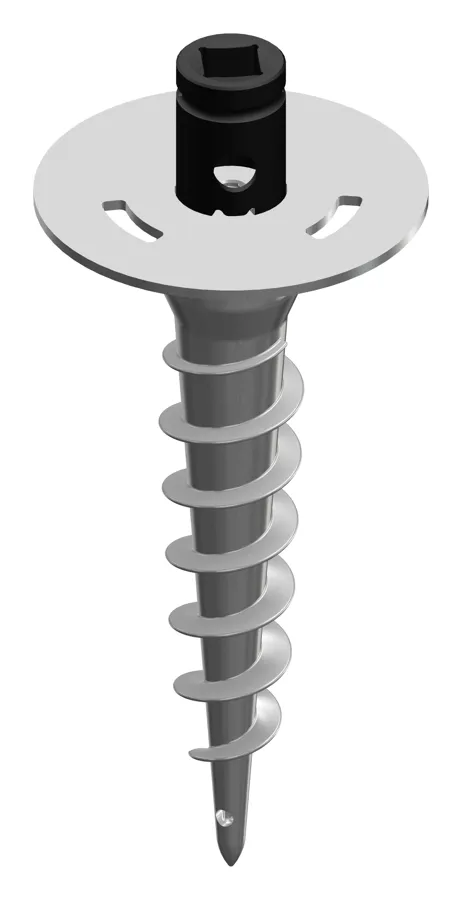
The Fastshifter Trident Drive is a short ground screw (350 or 470 mm) with a wide head that is quick to drive in. It was designed for regions where the ground does not freeze, and for light uses where a long pile is unnecessary.
In the UK, that makes it a good fit for:
- outdoor and bollard lights, signs and posts with low loads;
- small free-standing garden items where a few millimetres of movement does no harm;
- frost-protected or free-draining ground, after checking the site.
It is not the right choice for the main supports of a deck on frost-susceptible soil or shrinkable clay. There, use longer screws so the load-bearing part sits below the active layer. Read more in our guide on deck foundations in frost-free regions.
Quick checklist
- Identify the soil: chalk or silt, clay, or free-draining gravel and sand?
- Note large trees nearby and any recent tree removal.
- Choose screw length so the load-bearing part is below 450 mm (≈ 18 in), deeper on clay.
- Drive a test screw on unfamiliar ground.
- For heavy structures or difficult ground, ask a structural engineer.
For help choosing screw lengths for a UK project, or samples, email info@fastshifter.co.uk.
Sources
Frequently asked questions
What is the frost depth in the UK?
There is no single official frost line as in some colder countries. UK house-building guidance treats 450 mm (≈ 18 in) below finished ground level as the minimum foundation depth in frost-susceptible soils such as chalk, and in cold-weather construction.
Do I need to go below 450 mm (≈ 18 in) for a garden deck?
For the main supports of a deck on frost-susceptible soil, yes: put the load-bearing part of the footing or ground screw below that depth so frost heave cannot lift it. On shrinkable clay, seasonal moisture movement is usually the bigger issue and calls for more depth.
Can I use a short ground screw in the UK?
For light, non-critical uses where a little movement does no harm, such as garden lights, signs or small free-standing items, a short screw can be fine. For deck supports on soil that can freeze or that shrinks and swells, use longer screws.
Which soils are frost-susceptible?
Fine-grained soils that hold water near the surface, such as silts and chalk, are the most susceptible. Clean free-draining gravels are much less so. Clay is treated mainly as a shrink–swell risk.